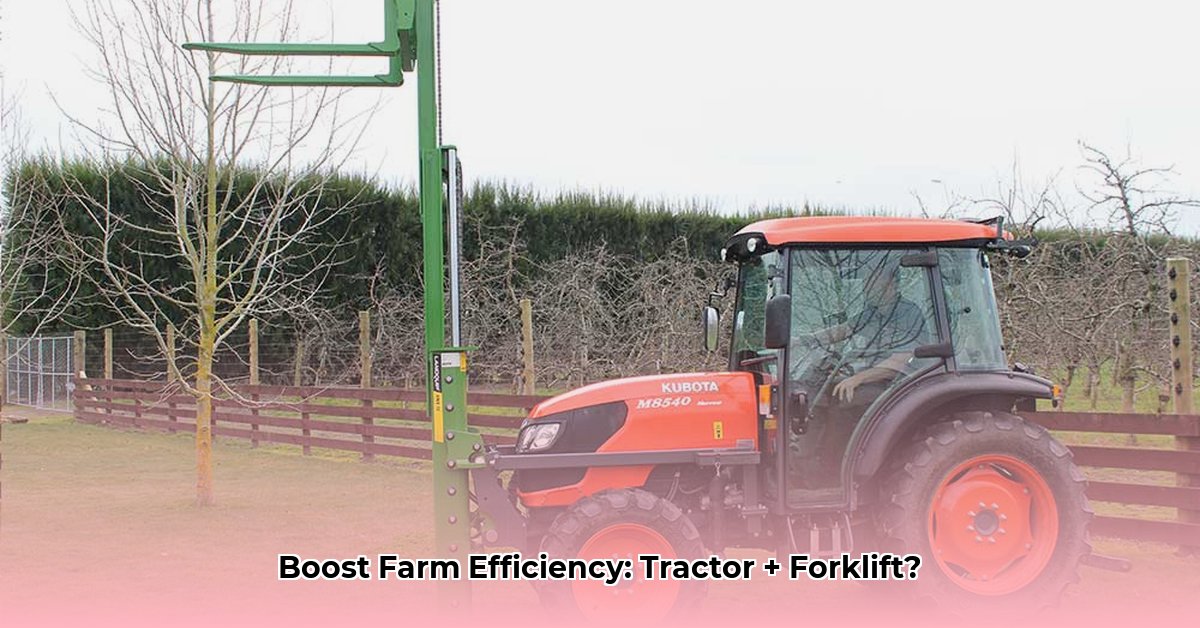
Types of Tractor Forklift Attachments: Expanding Your Farm's Capabilities
Tractor forklift attachments significantly boost farm efficiency, moving beyond simple pallet handling. Several types cater to diverse needs:
Pallet Forks: The workhorse for moving pallets of feed, supplies, or produce. Their standard sizes are adaptable, but custom options exist for specific dimensions. (Think of them as your farm's mobile warehouse.)
Bale Spears: Ideal for effortlessly handling hay and straw bales, significantly reducing manual labor and associated back strain, particularly during harvest. (These are a back-saver during busy harvest seasons.)
Bucket Attachments: Designed for moving loose materials like grain, soil, manure, or gravel, these versatile tools offer broad application across various farm tasks. (Consider these if you frequently handle loose materials.)
Specialized Forks: Beyond the basics, specialized forks exist for niche tasks like manure handling or oversized pallets. (These are tailored solutions for specific farm operations.)
Choosing the right attachment hinges on understanding your farm's specific needs and operational context. What are your most time-consuming tasks? What materials do you handle most frequently? Addressing these questions clarifies your requirements. How much weight do you regularly move? What is the greatest height you need to reach? For more information on attachments, check out this helpful resource: tractor attachments.
Choosing the Right Attachment: A Strategic Investment
Selecting the right attachment requires careful consideration of several factors:
Tractor Compatibility: Ensure complete compatibility between your tractor's hydraulic system, lift capacity, and the chosen attachment. Consult your tractor's manual or dealer for precise specifications. (Incompatible attachments risk damage to both your tractor and the attachment.)
Capacity and Lifting Height: Accurately assess the weight of your heaviest loads and the necessary lifting height. Overestimating capacity is preferable to underestimating, but avoid unnecessary excess. (Proper capacity calculation prevents overloading and potential accidents.)
Safety Features: Prioritize attachments with key safety features, including load stabilizers, overload protection, and emergency shut-off mechanisms. These features are crucial for operator safety and equipment longevity. (Never compromise on safety; it's paramount.)
Budget: Attachment pricing varies greatly, influenced by manufacturer, quality, and type. Consider both initial cost and long-term maintenance costs when making a decision. (High-quality attachments, while initially more expensive, usually reduce long-term maintenance costs.)
Installation and Operation: A Step-by-Step Guide
Safe and efficient operation depends on proper installation and adherence to safety protocols.
Step-by-Step Installation:
Read the Manual: Start by thoroughly reviewing the manufacturer’s instructions tailored to your specific attachment. (This is non-negotiable for safe and proper installation.)
Secure Mounting: Carefully attach the implement to your tractor's three-point hitch or quick-attach system, ensuring all pins, clips, and hydraulic connections are secure. (Double-check all connections for tightness and proper engagement.)
Pre-Operational Check: Before lifting any load, perform a test lift with empty forks to verify hydraulic function, check for leaks, and identify any unusual noises. (Detect any potential issues early on, preventing serious problems.)
Safe Operation: Always operate within the attachment's rated weight capacity. Maintain a safe distance from the load during lifting and movement. (Never exceed the rated weight capacity; Operator safety is paramount.)
Maintenance and Troubleshooting: Extending Equipment Lifespan
Routine maintenance is crucial for extending equipment life and preventing costly repairs.
Regular Inspections: Conduct visual inspections of hydraulic lines, pins, cylinders, and other components, checking for wear, damage, or leaks. Address issues promptly. (Early detection prevents minor problems from becoming major repairs.)
Lubrication: Regularly lubricate moving parts according to the manufacturer's recommendations. (Proper lubrication minimizes wear and tear, extending the attachment's service life.)
Cleaning: After each use, clean the attachment to remove debris and prevent corrosion. (A simple cleaning routine dramatically reduces the risk of corrosion.)
Regulatory Compliance: Adhering to Safety Standards
Always comply with all relevant local, regional, and national safety regulations and standards for operating agricultural equipment. (Ignoring safety regulations jeopardizes both operator safety and legal compliance.)
Future Trends: Technological Advancements in Tractor Forklift Attachments
Technological innovations are reshaping tractor forklift attachments.
Automation: Automated guidance systems, self-leveling forks, and automated bale-handling systems promise increased accuracy and efficiency. (Automation is steadily improving precision and efficiency.)
Sensor Integration: Smart sensors monitor load weight and hydraulic pressure, enhancing safety and providing real-time feedback to the operator. (Real-time data enhances operational safety and optimizes efficiency.)
Remote Operation: Research into remote control capabilities is expanding, particularly for hazardous environments. (Remote operation improves operator safety, especially in challenging conditions.)
By understanding and applying these guidelines, farmers can substantially boost farm efficiency and productivity while ensuring operator safety. Remember, adhering to safety protocols and conducting regular maintenance are key to maximizing the value and longevity of your tractor forklift attachment investment.